Remembering Bert Menco 1946–2025
by Diane Thodos
To be sure, Bert Menco was an eccentric and extraordinary artist, but exactly the same could be said about his personality. Born in Holland in 1946, Menco arrived in the United States in 1982 and worked and lived in Evanston for over 40 years before returning to his home country of the Netherlands in 2023. I still recall meeting him in printmaking class for the first time in 1993. One could not miss the colorful striped scarves he regularly wore, accompanied by often equally stripy shirts or waggishly colorful sweaters. Then there was his car—the multi-colored VW Golf Harlequin that matched his scarves, shirts—and sweaters. Wherever you saw that car, you knew that it had to be him! His Dutch accent could, at times, be somewhat impenetrable in a humorous way. He was ever ready to discuss politics, life, history, art, and culture, often laced with more than a touch of wild humor. When I would jokingly ask him an absurd question, he pitched me an answer that was twice as absurd. I never forgot his cartoonishly medieval version of our fast-food restaurants where “The Burger King and the Dairy Queen live in the White Castle.” He could be soft hearted, vulnerable and, at times, shy but also doggedly persistent when he set his mind to something.

He worked as a neurobiologist at Northwestern University, securing independent research grants to study the cellular biology of taste and smell. He published over 65 articles in international journals and other peer reviewed publications in addition to receiving numerous international awards. But I knew Bert primarily as a dedicated member of our printmaking group for almost 40 years, first at the Evanston Art Center, then at the North Shore Art League in Winnetka. He spoke of us as ”a great, great group of peers, for me especially important in the absence of close family in this country.”1 He mounted more than 20 solo shows of his work and received many awards and honors for his prints in more than 100 juried and invitational exhibitions. He often worked on large etching plates some which could take half a year to finish. Our whole group would wait in anticipation to see what new images he had arduously worked on as they came off the printing press—though sometimes his experimental print techniques could ruin the blankets. I never forgot when he put a small wasp’s nest through the press because it was made of “paper.” The result was an unforgettable mess. Yes, it was gross but also funny. His sense of humor was truly inimitable.
Bert was an irreplaceable part of the Chicago area art community—a kind of self-invented institution. He brought a European bohemian sensibility that kept us connected in a way that only he was capable of creating. Endlessly curious and social, he cultivated friendships with people from all walks of culture and life, always ready to talk about the best local museum shows, plays, and performances that were worth seeing. His prodigious appetite for literature inspired my own reading lists, whether it was Hannah Arendt, Franz Kafka, or Thomas Piketty. His house was like a small museum—a living slice of European culture, filled with books, prints, and paintings, including a sizable collection of prints by the surrealist Czech artist, Jiri Anderle. Then there were the curious mementos, ceramics, and assembled objects, such as a bizarre looking warrior mounted on a stuffed chicken that was itself mounted on bull’s horns. Nobody who visited his house ever forgot the warrior on the stuffed chicken!
He was a true supporter of the arts, organizing many group shows of local artists that gave the far-flung branches of our community opportunities to get to know each other. “This is a very honest artist’s town” Bert said, “with an incredible amount of talent, probably because so many of us have to struggle very hard to make it even a little bit.”2 He also got a number of our prints into the 10th Douro Printmaking Biennial in Portugal, transporting the work there himself. With ever a soft spot for culture and art in distress, he singlehandedly organized a local benefit to raise money for the Iraqi National Museum after it was looted in 2003. Ever active in politics, he would frequently fire off eloquent angry letters and emails to politicians against the defunding of arts, the war in Iraq, and of course, the fascist turn of our government. Bert would encourage us printers to continue our conversations after class, sometimes staying at a café or restaurant till two in the morning.
Bert was always passionate about his art influences, especially the works of Northern European old masters such as Hieronymus Bosch, Bruegel, Rembrandt, and Vermeer. Modernist art inspired him as well, including the works of Marc Chagall, James Ensor, and the German Expressionists. Nearly every year, Bert would leave for his studio apartment in Amsterdam, making the rounds throughout Europe to see traveling exhibitions featuring his favorite artists, always recounting his adventures when he returned.

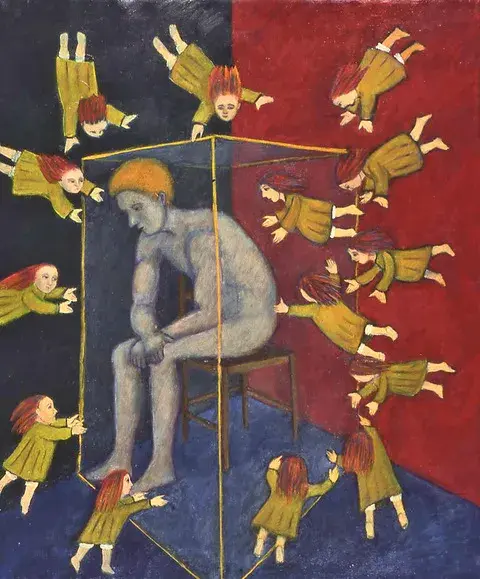
Of course, his art revealed deeper dimensions to everything we knew about him. The faces of his enigmatic characters are sweet and bitter, charming and grotesque, with dreamy expressions and sad eyes. They dwell in realms of fractured fairytales that scramble religious cultures and their iconography. Madonnas, harlequins, angels, devils, jesters, and imaginary beasts make regular appearances. It was easy to see the influence of the Belgian artist James Ensor (1860—1949) in Bert’s work, well known for his portrayals of bizarre masks and wildly grotesque caricatures that act out scenes of human absurdity and folly. Like Mark Chagall, Bert’s art often expressed the precarious lives of the European Jewish Diaspora, relating to the difficulty of everyday existence and the use of fantasy to express imagined means of escape. This comes as no surprise given his Dutch Jewish heritage.
I was born just after the war that divided the century in half. My mother and her family survived the bombing of Rotterdam, though only she and my grandmother survived the Holocaust. My father’s immediate family was completely annihilated, but my father survived the war, rescued by French communists. My parents met while they were refugees in Switzerland; they married on May Day 1945…. You try to understand that your whole family has been murdered, that you have no extended family—no aunts, uncles, cousins. It’s a very bizarre thought. 3
His experience as the child of Holocaust survivors explains the sense of longing and melancholy in his art. “History has had an unavoidable personal impact on me. The traumatic events of World War II affected every post war Jewish child, often by things unspoken. I am no exception… I think all of my work has that sadness in it from the Holocaust. “4

Bert’s use of the laborious mezzotint print process burnishes light out of velvety darkness, making his images all the more Gothic and spectral. One of his most memorable mezzotints, Rotterdam in Flames, recounts the May 14, 1940, bombing of the city that led to the Dutch capitulation to Nazi occupation. This single image made of 18 plates took two years to complete. It includes his grandfather’s journal entry describing the tragic destruction he witnessed that day:
Much of my interest in art came from my mother’s murdered father. He owned an important musical instrument store, arranged concerts in Holland for such luminaries as Louis Armstrong…He had attended art school and was very accomplished with watercolors and pastels, producing a beautiful sketchbook after he was forced out of his store by the Nazis.5
Like nearly all of Bert’s family, his grandfather perished in Auschwitz. At a Violins of Hope concert at Northwestern’s Pick-Staiger Hall two years ago, Bert was able to see and hear the playing of a violin that had once belonged to his grandfather. It was an emotional moment that resonated deeply for him, a way to make some kind of contact with his murdered relative through the art of music.

In The Golem (1988) the enlarged head of the writer Franz Kafka is projected over a crowded field of headstones representing the old Jewish cemetery in Prague. The historical figure of Rabbi Yehuda Loeb (1520-1609), the creator of the Golem legend, stands with outstretched arms. It seems as though he has resurrected Kafka as the “Golem.” The contemporary representative of Jewish history. Kafka is called upon 400 years later to write about questions concerning exile and the existential search for meaning that continue to haunt our contemporary conscience. The mezzotint Shylock 1943, Acta Fabula Est (The Play is Over) (2015) shows the Shakespearian characters Shylock and his daughter Jessica reunited in a concentration camp as they join a ghostly crowd heading to the gas chambers.

Of course, there are also many examples of humor and bemusement in Bert’s art:

Suitors (1994) shows a princess being carted away, tower, and all, by a gentle giant. A prince and death pursue her on horseback. Who will win? In the process she, or rather her tower is surrounded by all her belongings: bed, bike, tea, kettle clothing, telephone (no, she cannot call) and so on. The princess has long hair so that one of her pursuers may enter her tower by climbing up via her hair. Who will it be? 6


Manipulation (1996) is a sly commentary on power and control over other human beings. It depicts the large figure of a man wearing a star-spangled stovepipe hat with a clownish puppet on his hand who is, in turn, manipulating puppets on his hands, who, themselves, manipulate their own hand puppets. The smallest puppets have a “Punch and Judy” argument caused by the larger players in the drama. Pairs (1997) shows 24 different scenes of couples laid out on a playfully uneven grid. They look like so many tarot cards with characters acting out strange and funny little dramas. A head might get lost. A hand pops out of a floating hat. There are blindfolded singers and people with bandaged heads. Some wear masks, some are in grief, while others are in love. “All kinds of couples are in all kinds of conditions, trying to reach out and contact each other. The struggle goes on beyond the borders of the print, as partial images at the edge suggest. “7
Mutilated Alphabet (2003) depicts a crowd of 40 faces surrounding a large central figure and staring directly at the viewer. It began as a discarded plate that was originally meant for making an alphabet. “The plate was neglected and looked kind of hideous. I challenged myself, reworking it. I spent hours and hours on it. I used the pre-existing imagery of other people in the new image.”8 Thus, the fantastic contortions of each face blocked in by uneven shapes and an occasional letter. This claustrophobic crowd is a veritable encyclopedia of bizarre characters that only Bert’s restless imagination could have invented.
Bert was such a font of life and spontaneity that many of us simply cannot believe he is gone. I guess I’ll always be keeping that last voicemail he sent, wishing a happy Mayday, just to be able to hear his voice again—the ghost in my iPhone. When I think of clicking the “contact” link on his website, I imagine a humorous answer he would have for me, such as “I cannot respond right now because I’m floating in the ether somewhere—it seems gravity has stopped working.” Bert lives on in my imagination because he’s been such an irreplaceable part of me, as he is for so many others. My obsessive, creative, funny, strange, wonderful friend, how indeed we will all truly miss you!

Diane Thodos is an artist and art critic who lives in Evanston, IL. She is a Pollack-Krasner Foundation Grant Recipient who exhibits internationally. Her work is in the collections of the Milwaukee Art Museum, the National Hellenic Museum, the Smart Museum of Art at the University of Chicago, the Block Museum at Northwestern University, and the Illinois Holocaust Museum among many others. For more information and to read more of her published art writing visit dianethodos.com.
Footnotes
artofchicago.com 2/12/2001 Stephanie Hayden
Ibid
A Self-Portrait “Inside out” Contemporary Impressions, Fall 1998, p.6
Ibid
Ibid pp. 6–7
Ibid p.7
Ibid p.7
Uturn.org, Bert Menco Interview, by Julie Reichert-Marton 2000.
© All rights reserved
TwitterFacebookDribbbleYoutube


Thank you for this, Diane. I used to see Bert around the EAC but never met him. He must have been a very interesting friend.